Friday, December 31, 2021

International Travel During The Pandemic

I'm writing this as I'm sitting in quarantine. My opinions are thusly shaped by this situation. I realize that I should've brought more things and taken various things into consideration, and so here they are.

Before I even get into it, I'm going to strongly advise against international travel until such a time as there are no pandemic related restrictions. The strategies that various countries are engaging in may cause you delays or in some cases complete changes in your travel plans. Travel inside the continental USA, aside from some of the really weird places, is completely free and you won't get stuck. If you do get sick, medical care is, quite literally, first world and has the best chance of taking care of you.

If you choose to ignore my advice, then be prepared for a trip that could be extended for days, if not weeks, should the worst happen. This means that packing light is contraindicated, at least based on my experience. You should pack more of:

Clothes. Especially underwear and socks. Anything you don't want to wear over and over again, I'd bring more of.

Toiletries. A full tube of toothpaste would be an excellent start. If there's anything in your kit that looks like it is almost out, just replace it with a full item, or include a full item if there is room in your luggage.

Medication. Bring cold and allergy medications, even if you aren't currently suffering from either. Extra first aid supplies are probably not a bad idea. If you have any prescription medications, I'd bring several weeks worth. It won't hurt.

Cash. Bring enough to subsist well beyond what you'll need for the trip. You may need more for food, lodging, supplies, tips, or donations to public servants' charity funds. 

Entertainments. A fully charged kindle with several books on it is a great start. Even if you are completely without internet or data signal, this will keep your mind from turning into mush. If you're going someplace where internet is available, you may wish to also have a laptop or anything else that you use to interact with the world and your workplace. You may end up having to work remotely for some stretch if the worst happens. Also, a set of earbuds isn't a bad idea. Depending on where you are going, you may wish to bring the cheap ones, and you still will probably only want to use them in safe places. Doing otherwise may get you targeted for property removal/redistribution.

Batteries. If you have anything that requires charging, you definitely need to bring chargers for them. You may want to have an external battery that you can charge phones, tablets, and laptops from. And if you still have anything that requires disposable batteries, bring spares of those too.

Laundry detergent. Bring along a small box or pack of this. If worse comes to worse, you can hand wash clothes in your sink and then hang them to dry. You can also get a very light and packably small clothesline to hang your stuff up. That is definitely going to be on my future travel packing lists. I'm looking hard at the Sea to Summit Clothes line. It is $14 as of this article and weighs something like 1.3 ounces.

Dish soap. A small bottle of Dawn or similar will help considerably if you end up having to eat with the same plate and utensils repeatedly.

Tripod or selfie stick. Sounds weird, but if you have internet, you'll want to video chat with your loved ones who aren't with you. Sitting your phone up against walls and bookshelves starts to get old really quickly. Trust me on this one. They are pretty cheap on amazon.

In general if you think of what you'd bring as your normal checklist, pretend that your trip just stuck for 14 more days. If that happened, what would you add to your packing list? That will be your best clue. It may also be smart to have a bag or luggage that isn't completely stuffed full at the beginning of your trip. If you need to add to what you're carrying mid-trip, you'll have some convenient place to stow your new acquisition(s).

I wouldn't wish on you an extended stay against your wishes, but if it does happen, make sure you are prepared for it! If there's anything I've missed, email me and let me know!

Monday, December 27, 2021

The Expanse (Book Series) Review

 I just finished the series last night, and I have feelings. This series is of epic proportion, but grounded solidly as a story about people. While the TV series on Amazon Prime certainly serves as a companion and also a standalone, the book series is different. I suspect that the TV series will end with season 6 due to reasons that I won't divulge due to serious spoilers. Also, there are things they changed in the series due to the constraints of a televised series, and at least one thing due to the behaviors of one of the actors on the series. From here on when I refer to "the series," I will be talking about the books, unless I specify otherwise.

The series begins with events that happen in our solar system. The time is the future and we have expanded beyond the earth. The factions as they stand at the beginning of the series are Earth, Mars, and the inhabitants of the asteroid belt, aka "The Belters." While there are political machinations going on throughout the series, the politics aren't the center piece, which is fortunate, because if it were all about political maneuvering, I wouldn't have finished the series. The individuals who drive this story are the central force in all of the books, and no matter how fantastical the series gets, the characters in the story are what you care about.

The series explores a lot of things that interested me: how other intelligent life in the universe might evolve, how humans might react to the reality that we aren't the only life in the universe, and how humanity, even after time and technology evolve, are probably going to remain quite the same. This could be heartening or depressing, depending on which aspects of human behavior the series focuses on. For the most part this is a human tale, and while it sees the bad behavior, there is a lot of honorable behavior here as well. What humanizes the story the most, at least to me, is that the story is told completely through the point of view of the characters in it.

The series is penned by two authors, Daniel Abraham and Ty Franck. They authored the books under the pen name of James S. A. Corey. Unlike some other books I've read that were co-authored, this series doesn't have that disjointed and sometimes jarring feeling that one can get when a series uses two different writers to accomplish a task. Somebody smarter than me might be able to pick them apart more by writing style, but I didn't see any breaks. 

The Critical Drinker did a video on the TV Series, and he recommended it highly. One of his observations of the TV series was that it did diversity well. The characters are completely diverse, but it isn't remarked on, nor is it something that smacks you in the face. The future, as the writers have conceived of it, has a lot of mix of white, Asian, Hispanic, black, male, female, etc., and nobody cares. People are just people. The books from which the inspiration derives are similar in that the characters are of various colors and backgrounds, but that is simply what they are, not what they do or who they are. Likewise the female characters are all three dimensional, and their strengths aren't due to "grrrrl power," but instead derive instead from how they have lived their lives and the experiences and training they got from their past. 

If I would throw one half-hearted critique of the series, it is that Jim Holden, the main character, has a lot of crazy shit happen to him, more than one would expect due to reality and the relativistic universe. When you start talking about events taking place in multiple solar systems and galaxies, having one character span them all seems a bit far-fetched, but that one thing aside, that centrality also drives the narrative. 

In the end, the series is big. Like alien inteligences, light years, and time beyond comprehension. It is also small, like a person, a group, or a family. It juxtaposes both of those concepts so well that the balance happens without you having to consider it. Every time it throws big concepts at you, it does it through the eyes of the people experiencing it. When I finished it I was both overjoyed and sad, and that is a rare feeling for me when it comes to reading a series.

In short, I recommend it!

Sunday, December 12, 2021

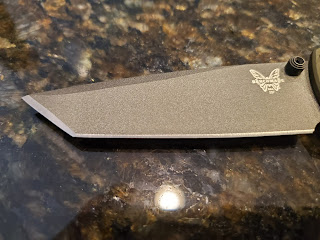
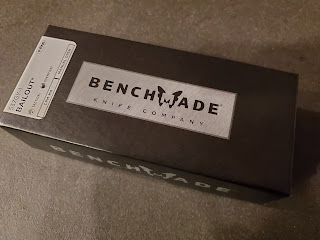
Benchmade Bailout 537 First Look

 Before I write anything about this knife, let me address the political situation with Benchmade. You can read about it here, here, here, and here. I could probably write an entire post about that situation, but this is not that post. Read on if you want to know more about the knife.

I own a Benchmade Bugout, and I find it to be an excellent knife. It is the knife you carry when you don't want to carry a knife. It disappears into a pants pocket and I struggle to remember that it is there when it is time to undress at the end of the day. It became my default knife for when I wasn't working or wanting a bigger knife. I remember talking to a Secret Service Agent about it, and he referred to the Bugout as "life changing." I don't know if it meets that level of hype, but for something so small, it definitely punches above its weight class. You could acquire one and do a bunch of destructive testing, or you could just watch this video and trust that they're pretty durable.

Now, we all probably understand how good the Bugout is, so why am I talking about the Bailout?

So I heard about the Bailout and how it was just ever so slightly bigger than the Bugout, with some different steels and profiles available. On two of the models it also features a glass breaker pommel, which seems like it could come in handy in some situations. Some of you probably feel that feature is over-rated, but I don't know that I can weigh in one way or the other. Your chance of getting stuck in a vehicle under water is low, but it definitely isn't zero. If you're in law enforcement, having access to one may be of use in other situations as well. ASP batons aren't great for breaking windows, and if you don't believe me, ask any poor cop who has tried it. There is a very specific technique and place to hit windows, and even then you have to apply a lot of effort.

Now the Bailout comes with exactly one blade profile, the tanto. Historically I haven't been the biggest fan of that profile, but if you're trying to create a more durable blade profile, this is definitely one way to do it. By profiling the blade as a tanto you put a lot more blade steel closer to the tip, which should help resist blade deformation or snapping if you use the tip as any sort of pry. (Not that you should do this, but sometimes if you're forced into a situation of bad choices, you do as you must.)

My Bailout arrived directly from Benchmade, which I purchased with my own cash. I suspect that I could've scrounged it up more cheaply from other sources, but Benchmade had it in stock. I paid something like $238 for mine if memory serves. MSRP is $260, but I see it available as low as $220 from Knifecenter and Blade HQ. As of this writing they are still calling it a pre-order though. When I got it the knife was in excellent shape, as you would expect. Blade was centered and the opening and closing required no break in to get it to flip open and closed easily. The pocket clip was installed for right hand pocket carry, but as I am a lefty, I swapped it. There was some evidence of additional thread locker on the scale behind the clip, but nothing that bothered me overly. The scales are very thin but surprisingly grippy for their size. If I had any complaint, it was the initial sharpness and grind angles of the primary cutting bevel. The knife certainly arrived reasonably and usably sharp, but it wasn't overwhelming. I stropped it a lot and it got better, but still not what I would want.

I ended up breaking out my Apex Edge Pro and getting all of the grind angles the way I wanted them. (Approximately 21 degrees.) It took me about 30 minutes of work to get things as I wanted. I then hit the edges with a strop for about 10 passes per side. When I was done, the edge would quite readily shave hair from my arm. (I have several bald patches now.)

One other downside to tanto profile blades is that you really have to sharpen it like there are 4 edges rather than 2. It basically doubles the time it takes to sharpen them. Also, if you're not careful, you can quite readily round off some of the angles of the blade. I would not use a belt sharpening system to sharpen a tanto, or at least not one you care about. 

Lastly let me mention the blade steel, which is CPM-M4. If you google it up, you'll find out that it is a "high vanadium special purpose high-speed steel." Doesn't that sound nifty? If you're a knife steel nerd it might tell you all that you need to know, but for those of us who don't obsess over the amount of chromium and other elements in any given steel formulation, what do we need to know? Firstly, you probably want to know that M4 is not stainless. This is one of the reasons why the blade has a coating on it, in order to deter corrosion. That said, you really need to keep a knife like this clean and wiped down every so often, or it will definitely rust on you. M4 is known for durability and edge retention, and it can definitely take a very fine and sharp edge, at least based on my work getting this one to where I wanted it. 

If you're looking for a small knife that is very capable and not horribly expensive, I would still steer you toward the base model Bugout. That can be found for around $130 at the time of this writing, comes with a S30V blade which is definitely stainless and also takes quite a good edge, and the profile of the Bugout is probably better suited to all sorts of tasks. The Bugout is the knife I recommend to police recruits who don't want to carry any sort of big knife, or for carrying while not at work. 

That said...

If you want something slightly bigger than the Bugout. If you want something slightly more capable than the Bugout. If you want something slightly tougher than the Bugout, then the Bailout is your knife. It still only weighs 2.7 ounces, which is stupidly light for a knife this capable. It'll require a bit more maintenance and upkeep, and it costs about double what the Bugout does. But if you need that additional capability, with the same very small and light package, the Bailout is definitely your knife.

Please note that my Amazon links are affiliate links. If you purchase any of these items through these links it will get me a small percentage of the cost of the item, but at no cost to you. This helps me offset my expenses for running a business, such as hosting fees and buying items to review. Thank you for reading this review!

Wednesday, December 8, 2021

Various Thoughts

 I don't have enough of anything for an in-depth writing, but here are a few random things...

I am still seeing ammunition pricing creep down, but slowly. If you dig you can get a case of 9mm for under $400 right now. That is still painful if you're remembering those good old days when you could scrounge up some for $180 a case. I don't know that we'll ever see that again, or if we do, it probably won't be during 2022. SG Ammo, Roger's Sporting Goods, and Norma are all good sources for inexpensive ammunition. Lucky Gunner is OK, but their pricing is higher usually. That said, if you can't find it other places, you may have more success at Lucky Gunner.

I saw a picture of the new Steiner MPS in Aaron Cowan's hands, which means he is probably beating it to death as I'm writing this. Looking forward to his video results, as this optic is a brand new entry in the pistol mounted optic world. There are really only three players right now, Trijicon, Aimpoint, and Holosun. As far as I know, most of the other entries out there are using Holosun electronics and changing the packaging up to one degree or another. I could be wrong on that last point, but I've heard it from multiple sources...

Speaking of pistol mounted optics, there is at least one major agency in my area changing over to them completely. Some local agencies have authorized them for some uses, but this will be the first agency going all in. I'm expecting good things, more to come on this one as I see it play out.

I ordered a Benchmade Bailout and will be getting it on Friday. I'm not the biggest fan of tanto style blade shapes, but the overall size and feature set got me curious enough to actually sink some cash into it. I'll be curious to see how it goes, but it may make my list of recommended folders. Speaking of that list, I probably need to write it out and publish it. That's something to do, but not tonight.

Speaking of orders, I have two things hanging out in the "ordered but still waiting" category. One is a slide that was sent to Agency to get their AOS installed. They quoted 20 weeks, which means I'll see it in March, I think. I also ordered a KKM barrel for my Glock, and I think their quoted turnaround for nitrided barrels is around 17 weeks, so that means I'll see it before that AOS slide, but not by much.

Sunday, November 14, 2021

Sights, Eyes, and Brain

 Let me preface this article with some disclaimers. One, I am not a PhD, nor do I have extensive coursework in vision and the human brain. I am not a medical doctor, optometrist, ophthalmologist, nurse, medic, EMT, or paramedic. I'm just a guy that has spent a few decades teaching people how to shoot. That has put me alongside shooters that are brand new and shooters that are GM level, and everybody in between. I'd like to mention two individuals who have probably delved deeper into shooting and vision than most others, and those two would be Gabe White and Tim Herron. If you want an extensive discussion on vision and shooting, those two guys should probably write a book on it, or maybe two. But since they haven't, I'm going to be using some of what I know and what they teach to discuss vision and shooting, especially as it relates to using iron sights on a pistol. If you have a chance to take a class with those gentlemen, I highly recommend it. While you're there, if vision as it relates to shooting is something you're interested in or invested in, ask them direct questions about it. Tim Herron's methodology of using iron sights is a real game changer, and it explains his accuracy at speed. Gabe White's work revolves around focus and how some functions of the eye can be isolated. Once again, take a class and bother him with questions about this, it is worth your time.

If we look at the problem of using sights to aim a pistol, it sounds a little wild on its face. We are asking a shooter to line up 4 things and hold that line up as we complete the process of shooting the gun: eye, rear sight, front sight, and target. We are also asking them to learn that line up well enough to be able to do it repeatably and rapidly, such that it can be done in fractions of a second. And as we are repeatedly told, we can only focus on one of those things directly at a time. If you've ever been on a police agency firing line, you've doubtlessly heard one or more instructors chanting over and over: FRONT SIGHT! While such admonitions can be helpful at times, this instructor has doubts that if you've told somebody "front sight" 100 times, that the 101st time will be the magic trick to make them shoot accurately.

From: Align The Sights

Of course some of these issues go away on a pistol mounted optic setup. Now we take the line up from 4 down to 3, and the shooter can stay target/threat focused through the entire process. The only issue is that if you're an instructor and you are teaching open enrollment classes, somebody is going to show up with an iron sighted gun and you're going to have to be able to teach them. Even if everybody is running a pistol mounted optic, we still have to be able to teach people how to shoot efficiently should that optic fail, and that typically involves iron sights.

Higher level shooters will often describe sighting a gun as "seeing what you need to see in order to get your hits." That is a very simple phrase but not helpful to a beginner at all. They have zero frame of reference in order to make it work in a practical sense.

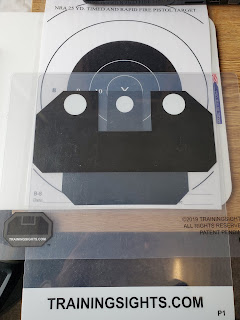
The basics of teaching people how to use iron sights tend to fall into categories like visual aids and descriptions. Everybody has probably seen a power point with pictures showing a perfect sight alignment on a background target. Such visual aids as those made by trainingsights.com are also very helpful. There is always the oft used mantra, "equal height, equal light." If you have a blue gun or other inert gun like object with sights on it, you can use it to aim at the student's eye so that they can get a reciprocal/backwards view of what a proper sight alignment looks like. I find that if you've used all of those, you'll probably capture something like 95% of your students enough to get them going.

That last 5% is where things get interesting, and what has led me to believe that we don't all perceive things the same way. Differences in visual acuity, astigmatism, physiology, brain chemistry, planetary alignment, and such, all make us different. Something about that Fight Club quote about us all being unique snowflakes? Because if we were all the same, those pictures and descriptions would fix all the problems and we could go on with teaching how to grip the gun and properly press the trigger. But sometimes the sighting issue is the sticking point. One of the things that plagues new shooters is the want to see what is going on at the target. This is perfectly natural and very normal, but it is also something that must be overcome to some degree if we want them to become proficient with iron sights. Even if a new shooter doesn't focus completely on the front sight, but they can interrupt their visual line with a properly lined up set of sights, they'll hit. Soft focus is a thing and I find that as I age, soft focus is basically my only means of using iron sights.

But back to our struggling shooter. Here is where some specialized tools and techniques will often help you diagnose the problem. The first one I resort to is typically a SIRT pistol. Have your student aim at the target, or at least how they think "aiming" works, and then have them press the trigger while you look at the target. Where the laser lands is a huge clue as to what they're doing with the sights. Many times people think they are looking through the sights when in actuality they are looking over the sights, still attempting to see the target. Historically a lot of instructors have placed an empty shell casing on the rear sight, forcing the shooter to look through the rear sight properly. That works, but it can't be done at speed, as the instructor must place a shell casing on the rear sight, then have the shooter shoot. Obviously recoil and the firearm cycling will throw the casing, so then the instructor has to do it again. I've taken the shortcut of putting a piece of masking tape across the top of the rear sight. I just tell the shooter than if they're seeing the front sight under the tape, they're good, and if they're seeing it over the tape, they're wrong. In most of the cases where I've done this, I've helped the shooter immensely.

I am so happy with this that I may very well pre-emptively do it on the first few days of working with new shooters in order to teach them how to see through the sights, rather than over them. I don't think this is a panacea, but it definitely works for some of that problematic crowd.

One last thing that you may wish to try if none of the above techniques work, and that is give the student a marker and some paper and have them draw what they're seeing. I have seen some excellent instructors stymied with frustration until they've resorted to that. From the student's drawing you can sometimes steer them in to what they should be seeing.

As a very experienced shooter it is often difficult to translate what you do and see into something usable for a newer student. This is probably the biggest challenge of being a long time firearms instructor. I combat this by watching and learning from a lot of other instructors, because their viewpoint and verbiage gives me a lot of ideas as to how to communicate these concepts. If I stay a student, then hopefully I'll continue to be able to communicate to a student.

Thursday, November 11, 2021

Rifle Slings: The Basics

 So one of my good friends asked for an article about rifle slings. That is an exceptionally broad topic, so please understand that anything I recommend is going to be based on my own experiences and may or may not mirror your thoughts or the thoughts of whatever social media star you follow.

Rifle slings fall into three broad categories: single point, two point, and three point slings. Let's just throw out the three point monstrosities right now, those are awful. Getting into and out of one is akin to trying to stuff yourself into a spider's web, and they don't offer anything over a good two point.

Single point slings aren't great for much, but they are OK for very short weapons, such as a SBR or SMG. A lot of police agencies default to them due to their simplicity, but they don't do much to stabilize the gun when you're shooting it or when you aren't shooting it. Single point slings do offer you the ability to smack yourself in the shins or the cash and prizes with the barrel of your gun though, so they have that going for them.

As an aside, no matter what configuration of sling, if it has any elastic/bungie properties, it should be avoided. Those seem like they'll aid in comfort but they don't really. They are fun when you jump off of something such as the back of a truck, because the gun will often stretch down and then spring back, striking you in the chin with your own buttstock. Funny for everybody watching, not so fun for you. Plus the off chance that you end up chipping teeth from that impact, and your dentist does need another payment on their Porsche. Those slings shouldn't be used by anybody who is even remotely serious about their craft.

Typical rifles benefit the most from a two point sling. That sling can be used to carry the rifle, but it can also be used as an improvised marksmanship aid, depending on the sling and the configuration on the rifle. I've found the best success with one point being mounted at the end of the buttstock and the other point being pretty far out on the forend of the rifle. That gives you the most stability and carry options, but you need to have a sling that is adjustable enough in length to give you the capabilities of that setup. If you don't, you may be reduced to mounting the front or rear point closer to the receiver because there isn't enough sling to do the work. If that is the case, you are just dealing with what you have.

When I'm carrying a rifle administratively, I'll have my head and one arm through the sling. You can carry it on your front or your back like this. If you cinch down the sling a bit, it is quite stable and doesn't go flopping around as you carry out your non-shooting tasks. If I'm carrying it for shooting, I'll only have my head through the sling and wear it sort of necklace style, albeit with my hands carrying the rifle. If I need to transition to pistol, my neck will hold the rifle while I work with my pistol.

Let's discuss using the sling as a marksmanship aid. This won't be what you'll do in any sort of close range tactical work. This is more what you can do if trying to shoot targets at longer ranges, such as hunting or competition. Using a sling in this fashion helps the most with positions other than prone. Not that you can't brace yourself with a sling in the prone position, but I really find that getting into the sling helps the most with standing, kneeling, and seated. For me, I wrap my support side arm through the sling such that it is braced against my triceps, and then move my elbow up or down to decrease or increase the tension on that sling. The sling tension takes a lot of sway or wobble out of the sighting as I'm working at that point, if I've done it correctly. While I haven't played with it as much, there's another technique that loops your strong side arm through the sling and uses that method to reduce sway. That method takes a lot of weight off of your support side arm, and is also versatile. It may also be faster to get into. You'll have to play with both and see which works the best for you. As always, try it dry fire in different positions and see if there are differences in all positions.

I should also mention that you can use a sling to increase stability while using a shooting tripod. Much like using your arms as a brace, you can loop yourself into the tripod if you wish. The tripod itself provides additional stability, but it isn't as solid as a bipod and bags. Still, engaging targets at 300 yards with a tripod is child's play, using a sling or strap to further stabilize that makes it even easier.

Now, as far as slings that I've used with good success, here are some recommendations:

Viking Tactics Sling

This is one of the OGs of current sling technology. They have multiple options and configurations available, from the original to the ultra-light, to the wide/padded varieties. For those of you most interested in pure marksmanship uses of your slings, they have a sniper sling with cuff. The use of that type of sling is outside of the scope of this article. Overall, you could do way worse than to use a VTAC sling.

Vickers/Blue Force Sling

Another of the original great slings, and also available in a variety of configurations. The standard one has webbing that isn't as comfortable as the VTAC or the Magpul, but it is still a solid sling and it sits on one of my rifles as I'm writing this. Vickers also has slings set up specifically for SMGs, AKs, and M240s and M249s. There is also a convertible sling that allows you to change your sling from a two point to a single point as needed.

Magpul MS3 Sling

If you want to be able to choose between a single point and two point on the fly, this is the sling for you. It isn't perfect at either of those missions, but it has the flexibility to be OK at both. The sling itself is wide and comfortable, and the hardware is very durable. With some additional accessories such as QD sling swivels, you can mount this wherever you want on your rifle. The slider works well to adjust the length.

Sheriff of Baghdad B Sling

These are probably the lightest slings I've used that still retain full functionality. If you're doing a lightweight build then I would definitely choose one of these over the others. Despite that light weight, you're not giving up anything with this sling. The regular one uses narrower webbing than some of the others I've mentioned, and that is part of the reason that these slings are lighter.

Note that there are a lot of other slings out there that I haven't mentioned. I didn't leave them out because of any dislike, but simply because I haven't used them. The Proctor Sling comes to mind as one. People have said great things about it, but I have no direct experience with them so I haven't spoken about them. If you want one that I know works well, pick one of the ones I recommended. If you pick one I didn't, try it out and let me know how it goes for you!

Wednesday, October 20, 2021

When is your (rifle or pistol) barrel worn out?

 I was shooting on the range with a friend the other day and we were working on B-8 bullseyes at 25 yards. I was shooting my Glock 17 with an optic, and my friend was shooting his Glock 19, also optic equipped. He is an excellent shooter, but his groups at 25 yards were sucking on this day. It was so bad that at one point he rested his gun on a bench and repeated the exercise, with the same abysmal result. His group was stringing along in weird directions. He was using good factory ammunition, too.

I asked him how many rounds he had put through that gun, and he said somewhere between 80,000 and 100,000. To paraphrase that old movie that we love to quote, "in all the excitement he kind of lost track." I told him to trade guns, he shot mine and I shot his. When he shot my Glock 17, his group tightened up by better than half, whereas mine with his Glock 19 doubled. In other words, the problem followed the gun, not the shooter.

When we did some work at 10 yards with the same guns, the result wasn't bad. He was easily able to hold the 10 ring with most of his shots. The real issue didn't evidence itself until we put some distance between us and the targets. 

So, is his barrel worn out? For what he wants to do with that gun, yes. That gun is now shooting 8-9" groups at 25 yards. He wants a gun that will hold the 9 or 10 ring at that distance, so he wants a gun that will shoot around 4" groups or better at that distance. But please understand that this is his situation, and it may not be yours.

I had a rifle that was a good rifle. FN cold hammer forged barrel, chrome lined, excellent parts on it. At some point I was testing out different hand loads and none of them would print better than 3" at 100 yards. It got so frustrating that I bought some match ammo and it also printed 3" at 100 yards. That was my clue that the barrel wouldn't do any better. It was a good barrel, but I know it was tired, having done at least 12,000 rounds, and many of those at a very accelerated firing schedule. I replaced that barrel with a match barrel and it went down to 1" groups at the same ranges with good ammunition.

Not that you need a match barrel for good accuracy. Two other rifles I've built with BCM barrels were both shooting 1-1.5" groups at 100 when those barrels were new.

But back to the original question, when is your barrel worn out? It is worn out when it won't do what you want it to do. My rifle barrel that I swapped out I ended up giving to a friend, because he really didn't want or need a rifle that would shoot better than 3 MOA. For him that barrel was solid and it would probably be good for several thousand more rounds. For him it probably would've been worn out when the bullets would no longer stabilize and they started hitting the target sideways.

If your pistol has 50-60,000 rounds on it, and you're concerned about the ultimate accuracy of it, that may be time to see what it is doing and consider another barrel. If, however, you never shoot that pistol any further than 7, 10, or 15 yards, maybe it won't matter up until the accuracy degrades at those distances.

Rifle barrels are a different animal and will certainly get more wear and tear from high round counts. I've not seen an AR-15 barrel make it more than 15,000 rounds without being pretty ragged, and depending on what you're doing, it could certainly happen before then. For some match barrels, if you want ultimate accuracy, you may end up swapping them out much sooner, especially if you're shooting very hot ammunition. Certain calibers are also well known for burning up barrels. Every situation is different, and yours may fall wildly out of any of the parameters that I've mentioned.

I will just close with this. If your gun isn't doing what you want it to do, accuracy wise, there are several things to try. Firstly, have somebody else shoot it, somebody that you know can shoot well. If their results mirror yours, it is time to try different ammunition. If that doesn't work, a trip to an armorer or gunsmith is likely in order for them to diagnose what is going on, provided that you don't have those skills and tools yourself. If you do, then you'll obviously be able to decide, is it time for new parts, or possibly even a new gun? If you're shooting enough to wear out a barrel, the cost of your ammunition is going to outstrip your parts or gun costs by a huge margin, and if you're shooting that much, you probably want equipment that will perform to your standards.

-----------------------------------------------------------

As a side note, the only pistol barrel I've tried that I was satisfied with on all fronts is KKM Precision. I know there are a ton of manufacturers of aftermarket barrels out there and I haven't tested them exhaustively, nor do I plan on doing that. I have used KKM in 3 different guns and they've all been accurate and reliable, even when a bit dirty. I have one of their conversion barrels in my old Glock 22 and it has run amazingly well and amazingly accurately. I have absolutely no affiliation with them, aside from being very happy with their product. I have spoken to one of their engineers on the phone at length, and he was super helpful, despite not knowing me from any other individual that would call with questions. I did not identify myself as an industry insider, instructor, or law enforcement. As far as they were concerned, I was just some dude. Not that I was unhappy before, but after that call it certainly cemented my happiness with their product and service.

Privacy Policy for Pocket Prompter

Privacy Policy for Graydog Pocket Prompter Effective date: June 6, 2026 Graydog Pocket Prompter does not collect, sell, share, or transmit p...